Transforming Every List Item
Other Random Ideas:
- Move some/all of this to Lab 2 (same place it is now in the unit, just bump it over the line into the other lab where it's actually connected) --MF, 4/26/19

- revive some of Nesting Function Calls (teachers have been asking about it on piazza) --MF, 4/26/19
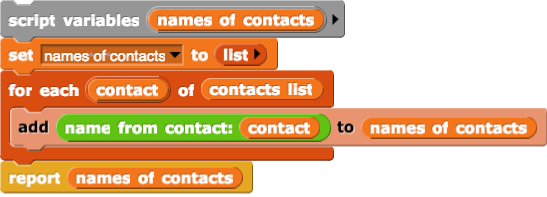
On this page, you will use your ADTs with the map block to display all the names in your contact list.
I think some version of the score adjustment question in the same items bank in the 2017 framework #22 on page 101 would be great. It's a program to add 5 to every score in a grade list unless that would make a score go over 100, then it's just 100. The students have to select the two responses (it's multiple-multiple choice) that perform the adjustment on each item. (They are given max and min functions.) I'd like to do a problem like this, where there is an adjustment being made to a list except in certain cases, but I don't want to copy this one. Thoughts on a different example? The best I can come up with right now is to adjust by a different amount and write our question without looking at the exam item. (Incidentally, and I DON'T want to teach it here prematurely, I wonder if we use the one-line IF in a HOF anywhere in BJC... U8? It could be presented as a simplification of this familiar problem...) --MF, 3/4/19
Also, I want to make sure we cover mutators well enough in shopping list/contact list because mutators, like them or not, are on the exam. --MF, 3/4/19
PG: I'd be happier if something happened with the result of #3 other than students having done it. Somehow this feels like an almost-lesson.
BH: Ditto. (I still want given and family names! We can make it doable.)
MF: This can't be the first place we introduce MAP
As you know, the keep block allows you to check every item in a list using a predicate, and it reports only the items that make the predicate true. The  block also lets you work across a whole list at once.
 Map allows you to perform the same function on every item of a list. Map takes two inputs: a function (a reporter with a blank input slot) and a list, and it reports a new list. Every item in this new list is the result of calling the function with an item from the original list as input. For example:
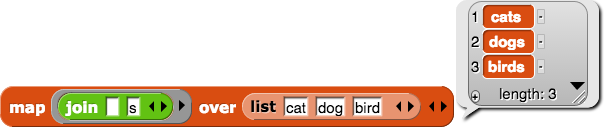
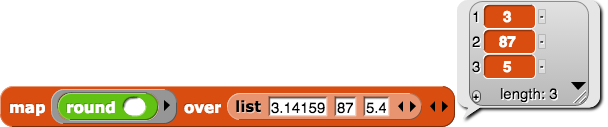
You write the function that describes the change, and map applies that function to each item in the input list and then reports the list of values reported by the function.
Notice that the function mapped over the list always has a blank input slot. With both map and keep that blank is required. This blank is where the list item goes each time the function is performed.
- If it isn't open already, open your U3L1-ContactList project.
-
 Experiment with these examples of
 map. Discuss and then explain in writing what these expressions are doing.



- Use the
map block together with your selectors to report a list of only the names of all contacts.
Self-Check: Map Block
-
This question refers to these two lists:


Which of these statements are true?
Choose all that apply.

reports the list
{r, 5, b, i, 3, k, 2, 3, t, 6}.
Correct.

reports the list
{rabbit}.
No. The blank space is expecting a list as its input, but map puts a single item from words and numbers into that slot.

reports the list
{Augusta, Boise, Columbia, Des Moines}.
Correct.

reports the list
{A, B, C, D}.
No. You can find the first letter of a word, but not the first letter of a list.

reports the list
{Maine, Idaho, South Carolina, Iowa}.
No. This is kind of a trick question. What gets reported is actually a list of lists. The output is: {{Maine}, {Idaho}, {South Carolina}, {Iowa}}.
-
Consider the non-abstracted code on the left and also the abstracted code on the right.
 Give two reasons why the use of abstraction in the second example is preferred.